KPop Demon Hunters Script: A Scene and Shot Breakdown
Study a KPop Demon Hunters scene through an edited script reconstruction, timestamped shot observations, and practical lessons for writing public conflict.
Looking for the KPop Demon Hunters script? Start with the International Screenwriters’ Association screenplay listing. For a scene study, watch Netflix Family’s official meet-and-greet clip alongside the notes below.
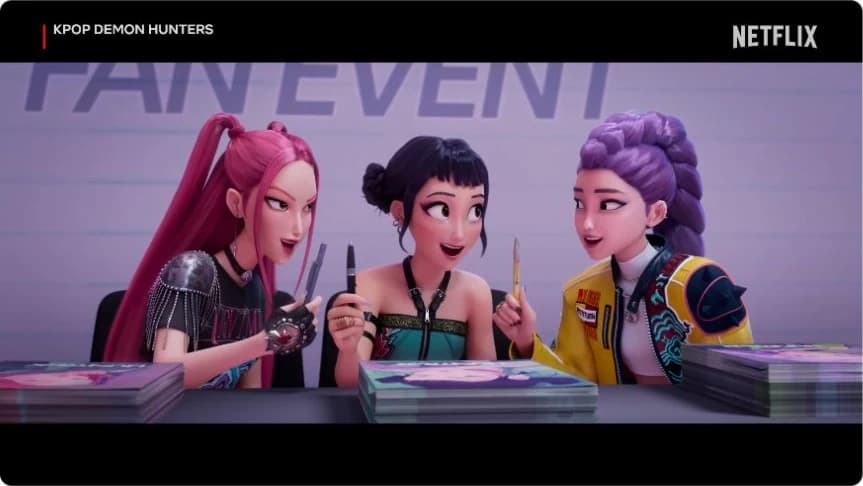
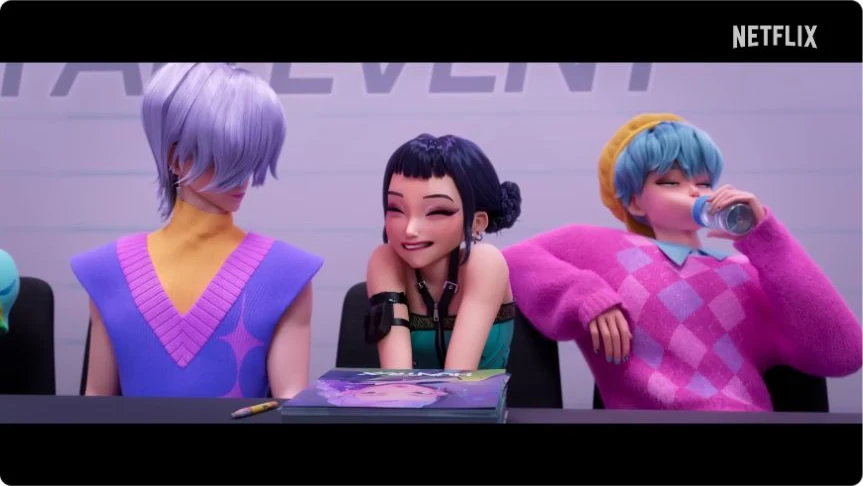
Cover: the signing table at 00:00 of Netflix Family’s official clip. All stills below come from this same upload.
This breakdown covers 00:00–01:50 of that upload. It is for writers studying how characters argue while maintaining a public performance. The script excerpts are edited reconstructions from the finished scene; they are not pages from the original screenplay.
The scene’s useful writing problem: Rumi must keep the signing event functioning while dealing with Jinu. The crowd makes private conflict harder to contain, but it also gives her a way to change the conversation.
On this page: screenplay and coverage · reconstructed excerpts · selected shots · writing lessons · storyboards.
KPop Demon Hunters screenplay and scene coverage
Use the ISA listing as a screenplay-resource starting point. Access conditions are controlled by ISA; this article does not promise a free complete screenplay or a particular draft version.
The source for the study is “The Saja Boys CRASH Huntrix’s Meet & Greet”, published by Netflix Family. Every timestamp below refers to this short upload, not the full film. The selected range begins at the signing table and stops during the public response near the end.
The distinctions matter when you take notes:
- A screenplay is a written production document.
- A reconstructed script describes the finished scene after viewing it.
- A shot observation records what is visible at a checked moment. It does not establish the shot’s complete duration.
- A storyboard is a planning drawing; a table made from the finished film is a different artifact.
Meet-and-greet scene: reconstructed script excerpts
The following passages are editorially condensed from a real Story script result, then checked against the official clip’s visuals and English transcript. Dialogue is paraphrased. Time ranges are viewing windows for these excerpts, not measured cut points.
00:16–00:28 — turn a threat into a seating decision
AT THE SIGNING TABLE
The arrival of the Saja Boys threatens to divide the fans between two setups. Rumi proposes seating both groups together. Her teammates object; the manager welcomes the solution.
Writing note: Rumi’s aim produces a visible action: put the rivals at the same table. The solution preserves the event while forcing the conflict into a more difficult physical arrangement.
00:50–01:00 — let an observer interrupt the private exchange
RUMI AND JINU, SIDE BY SIDE
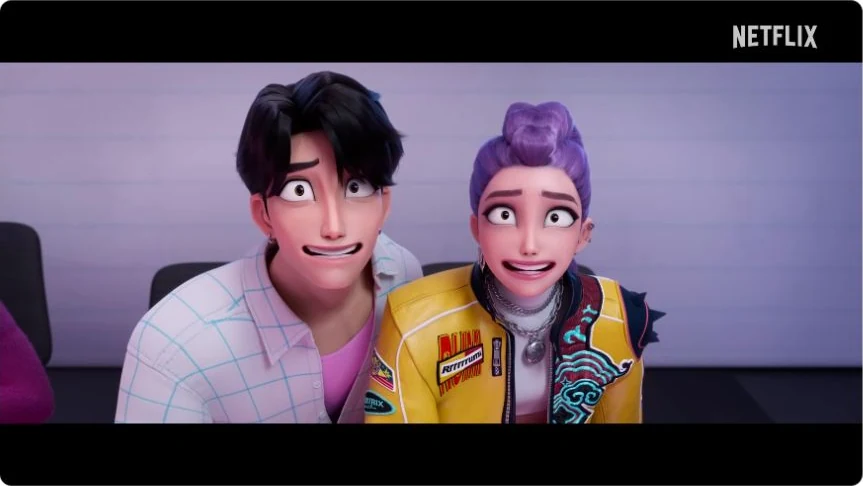
Jinu presses Rumi about telling her friends. She postpones the disclosure. A fan notices their whispering and offers discretion. Both idols turn their attention outward and put on strained smiles.
Writing note: The interruption changes what the characters can say. The fan does not share the context of their conversation, so a seemingly friendly intervention adds pressure.
01:35–01:50 — bring an outside response into the argument
A FAN APPROACHES JINU
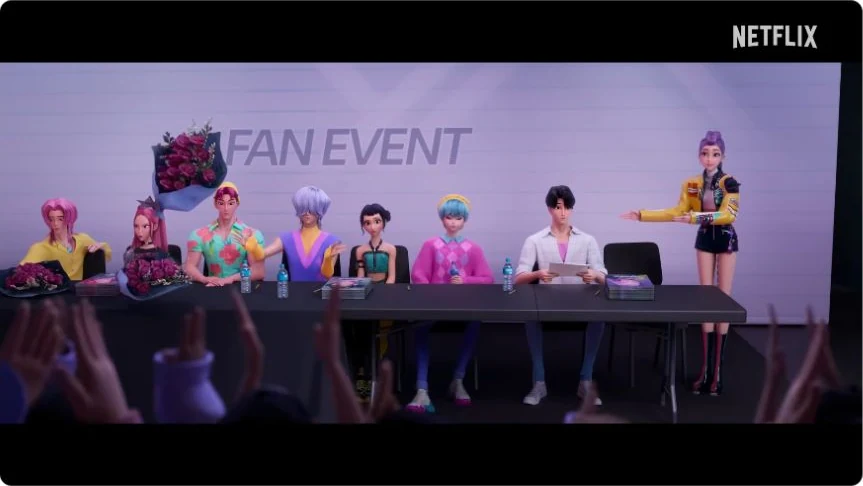
A young fan offers Jinu something she has made. He looks surprised, then down at the paper. Rumi redirects his attention toward the people supporting him and stands to invite the crowd’s response.
Writing note: The public setting becomes part of the answer to the private argument. The fan’s action gives Rumi something concrete to point toward.
Selected shots: framing, action and reaction
These are viewing checkpoints, not a complete shot list. Open the linked moment and watch a few seconds around it. The observation and interpretation columns deliberately do different jobs.
| Watch point | Visible observation | What a writer can study |
|---|---|---|
| 00:00 | The three Huntrix members sit together behind the signing table with markers and printed materials. | Establish the shared task before introducing competing agendas. |
| 00:05 | A wide view relates the table, room and incoming crowd. | Make the public stakes legible through space. |
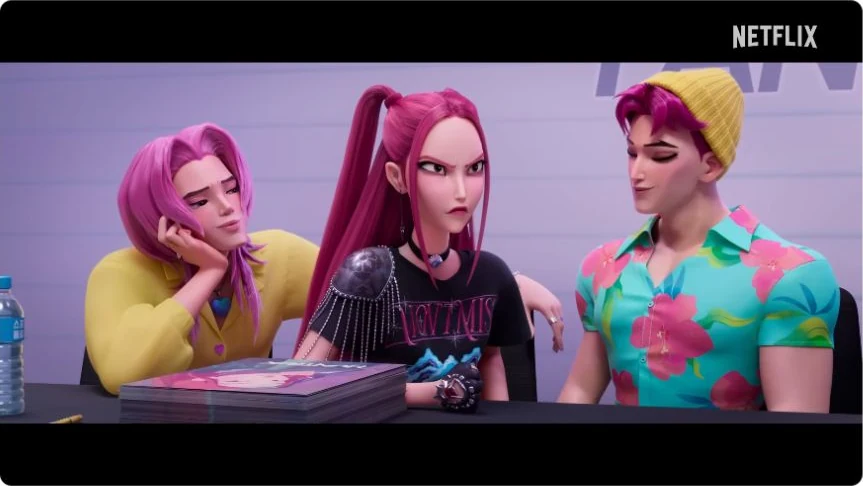
| 00:30 | Mira sits between two Saja Boys with a visibly tense expression. | Seating can carry conflict without an explanatory line. |
| 00:35 | Zoey smiles between the neighboring boys. | Compare her reaction with Mira’s; a group can share a problem without sharing a response. |
| 01:00 | Rumi and Jinu face outward together with strained smiles. | A reaction can reveal the effort required to sustain the public performance. |
| 01:05 | Mira and a neighboring Saja Boy compete over signing a fan’s cast. | Keep rivalry active through a small, physical task. |
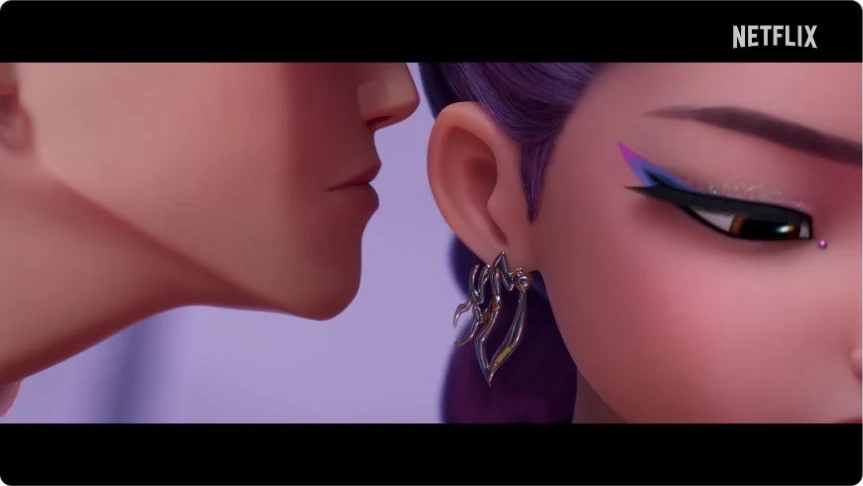
| 01:20 | Tight framing places Jinu’s mouth beside Rumi’s ear. | Compare this intimacy with the crowd-wide view; the same event accommodates different levels of privacy. |
| 01:50 | The framing widens to the table and audience as Rumi stands beside the seated Jinu. | A change in posture and scale can return a private exchange to the public setting. |
The last checkpoint marks the endpoint of the analyzed range; it is not a claim that the whole scene ends there. For a complete cut-by-cut exercise, use the method in our shot-by-shot film analysis guide and log each actual cut separately.
Three writing lessons to try in your own scene
1. Give the public task a practical consequence
In the 00:16–00:28 passage, the signing event is more than background decoration. Losing fans is a concrete problem, and Rumi responds with a seating choice. That choice creates proximity for the later exchanges.
Exercise: Put two characters with a disagreement inside a shared public task. Write one practical decision that keeps the task moving but makes their disagreement harder to avoid.
2. Write what each observer knows
Around 00:50–01:00, Rumi and Jinu have one understanding of the whispering; the arriving fan has less context. Their visible response changes when the fan addresses them. You can study the sequence without assigning an unspoken motive to the fan.
Exercise: List what each of three people knows before the interruption. Write the interruption so that the audience understands why the main characters cannot answer honestly.
3. Let an interruption supply the next move
Near 01:35–01:50, the young fan’s approach gives Rumi a new way to address Jinu’s earlier comments. Her next action grows out of something that happens in the room.
Exercise: Replace a line explaining a theme with an action from a minor character. Give the protagonist a response that changes the exchange, while leaving the larger conflict unresolved.
These are interpretations of the selected scene. They do not establish the filmmakers’ intentions or explain the film’s popularity.
KPop Demon Hunters storyboards and further study
For production drawings, see story artist Raymond Xu’s KPop Demon Hunters portfolio. It includes storyboard material from the film. The drawings are not presented here as a verified match for this meet-and-greet sequence.
To compare a storyboard with a finished scene, first confirm that the characters, location and action match. Then compare staging, shot order and what changed. A shared film title alone is not enough to establish a match.
How this study was made
One VidBreak Story script run produced a draft for the selected 110 seconds. We edited the excerpts, checked visible actions and subtitle context, and wrote the shot observations and exercises separately. Some generated beat times and character details required correction; the output was a starting point for review.
Use the same process on a reference you are entitled to analyze: generate a draft, compare it with the source, and keep observed details separate from interpretation.
Written by
Categories
More Posts
Vertical Drama Dialogue: How to Cut Exposition Without Losing the Story
Improve short-drama dialogue with three before-and-after scenes, distinct character voices, action-based subtext and a practical read-aloud edit.
AI Video Prompt Guide: Learn from a Reference Video
Learn to observe a reference video, annotate a real prompt and adapt it for a new scene, with an observation sheet and clearly labeled practice examples.
Micro-Drama Hooks and Cliffhangers: Before-and-After Examples
Write clearer micro-drama openings and episode endings with three original before-and-after examples, next-episode payoffs and a revision exercise.