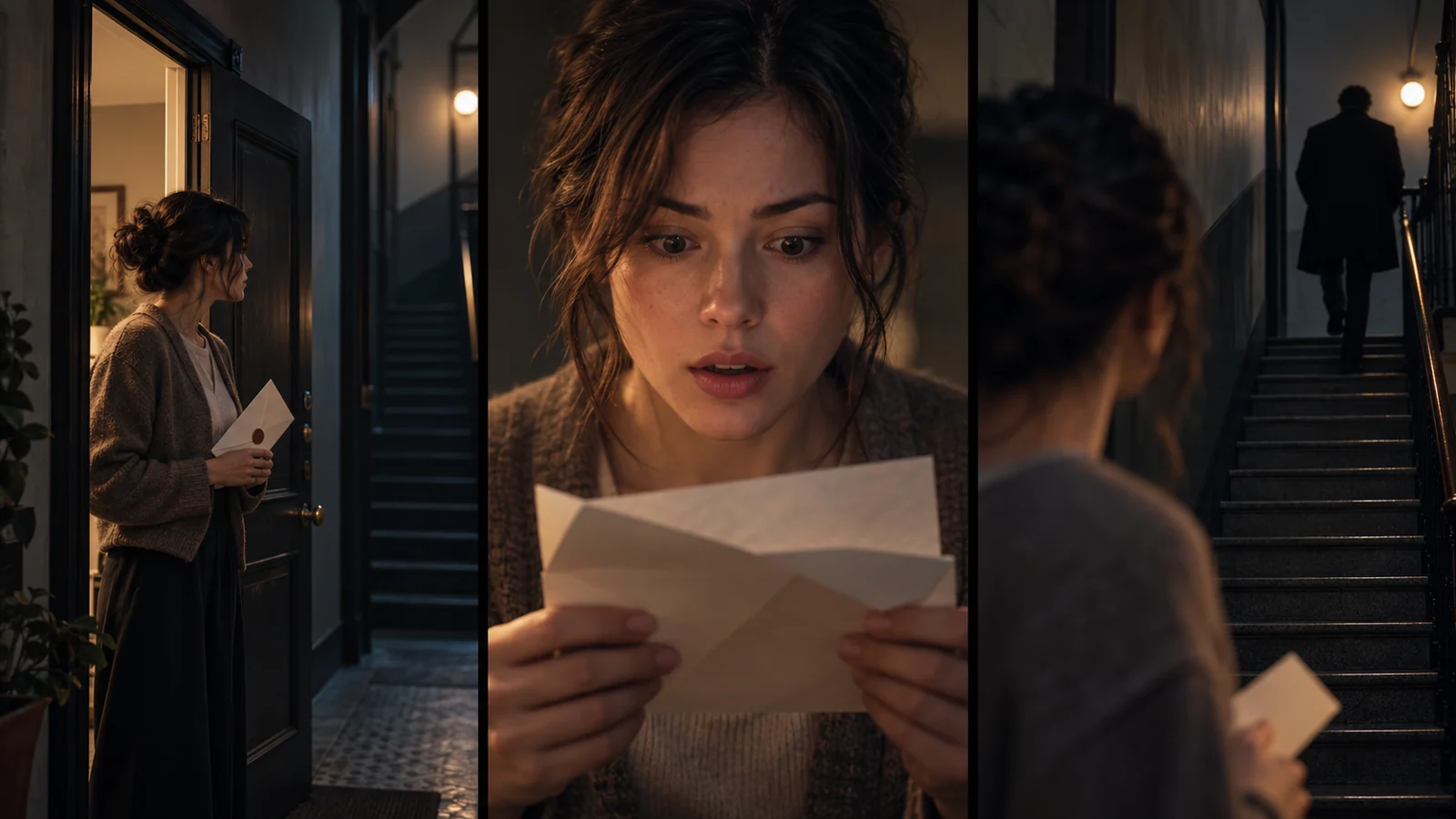
Vertical Micro-Drama Structure: How One Episode Leads to the Next
Understand beats, scenes and episodes through a complete three-episode story. Learn where to split a short drama and how to spot repetitive scenes.
A vertical micro-drama tells a continuing story in short episodes intended for a portrait screen. To structure one, decide what changes in each episode, then make that change lead to the next action.
The portrait frame affects what you can show clearly. The episode structure determines what the audience learns and why they continue. These are related decisions, but cropping a film vertically does not create a series.
Final Draft’s guide to micro-drama and vertical templates is a useful format reference. The three-episode arrangement below is our teaching example, not a required industry formula.
First, separate a beat, a scene and an episode
Imagine a courier delivering a parcel:
- He raises his hand to knock, then stops. That is a beat: a small meaningful action.
- The encounter at the apartment door is a scene: action in a shared time and place.
- The delivery becomes a family mystery when the recipient recognizes the handwriting. That can close an episode.
One scene can span multiple episodes. One episode can contain several scenes. A camera cut is not automatically a new episode.
Follow one complete story
In our original The Last Delivery sample, courier Ilya brings a parcel to Mara. They are siblings who have been apart for twelve years, but she does not immediately recognize him. He is afraid to announce himself.
The public sample has 12 timed story beats across three minutes, arranged into three one-minute episodes. It is hand-authored, with illustrative images rather than a playable source film.
Episode 1: An ordinary delivery becomes personal
Ilya knows the apartment before checking the address. He hides a wrist scar and cannot bring himself to knock. Mara opens the door and accepts the parcel. She recognizes her mother’s handwriting.
Ending: She asks who gave him the parcel.
Mara’s question makes the delivery personal and gives the next episode something specific to answer.
Episode 2: Recognition creates a need to act
An old delivery slip establishes the twelve-year delay. Mara opens the parcel and finds a childhood photograph. The names on the back connect it to her brother. When she looks up, Ilya has left.
Ending: She calls after him and goes to the door.
Why not end on the photo alone? His departure makes recognition urgent. If she stays still, she may lose the chance to speak to him.
Episode 3: The reunion happens
Mara follows him downstairs. His scar matches the bandage in the photograph. Their shared memory confirms his identity. She leaves the door open and invites him in.
Ending: He enters.
The series has answered its central question. This final episode needs a satisfying response, not another interruption.
Try two different break points
If episode one ended before Mara saw the handwriting, the audience would have a hesitant courier but less reason to connect him to her. That may suit a more ambiguous mystery, but it changes the promise.
If episode two ended after Mara had already caught him downstairs, it would consume part of episode three’s recognition scene. You might choose that version, but would need to rebuild the remaining episode.
A good break depends on what you want the next episode to do. Do not split solely because a timer reaches sixty seconds.
Diagnose an episode that feels slow
Write one sentence for each event. Underline the events that change a decision.
“Suspects the courier, notices another suspicious detail, says he seems suspicious” repeats an idea. “Recognizes a clue, discovers he is leaving, follows him” changes behavior.
Then test the vertical frame: can the handwriting or photo be shown legibly? Does the reaction need its own shot? Keep important evidence close enough to read without filling the scene with camera terminology.
Use this three-sentence outline
At the start, the protagonist is trying to...
Then ... happens, so they must...
By the end, ... has changed, which leads to...
Fill it in for each episode of a reference, then for your own story. Read the full screenplay, or use the first-draft tutorial when you are ready to write dialogue.
VidBreak reconstructs existing video into story scripts, professional episodic screenplays or AI video prompts. Choose a story script with optional Viral DNA to study hooks and pacing; choose an episodic screenplay to study longer drama material, up to 60 minutes per task. Automatic episode organization still needs comparison with the source.
FAQ
Must every micro-drama episode be one minute? No. Follow the project brief and test the performed length. One minute is the editorial choice used in this sample.
Does every scene need a reversal? No. A scene can establish a necessary fact, develop a relationship or deliver a consequence. Check whether it earns its place in the episode.
How do I know if two episodes should be combined? If the first has no meaningful change and the second simply completes the same small exchange, try reading them together. Combine them if the result is clearer and fits the required runtime.
Written by
Categories
More Posts

Video to Prompt: Build a Clear AI Video Prompt from a Reference
Turn reference footage into a usable AI video prompt with an observation sheet, worked text-to-video and image-to-video examples, and a troubleshooting table.
Faceless YouTube Videos: How to Add Value Beyond Reused Clips
Plan a faceless analysis video around an original question, useful commentary and a worked script outline. Understand reused content and what cosmetic edits cannot solve.
Shot-by-Shot Film Analysis: A Worked Example and a Useful Worksheet
Learn how to analyze a film scene with a shot log, separate observation from interpretation, and turn your notes into a clear argument about storytelling.